
Yellow Boxes and Dual Carriageways
Junction rules that depend on timing, space and lane discipline.
Why This Matters
These topics are often misunderstood because the correct action depends on whether you can fully clear the space, whether you are turning right and whether there is room in the median.
Coach Note
A lot of mistakes happen because learners react to the car in front instead of judging the space ahead for themselves.
Learning Goals
- Know the rule for entering a yellow box.
- Understand the limited right-turn exception.
- Use the left lane correctly on a dual carriageway by default.
- Know when it is safe to use a median space.
- Finish turns into the correct lane.
Sections
Yellow Box Basics
Never enter unless you can clear it without stopping.
Core Rule
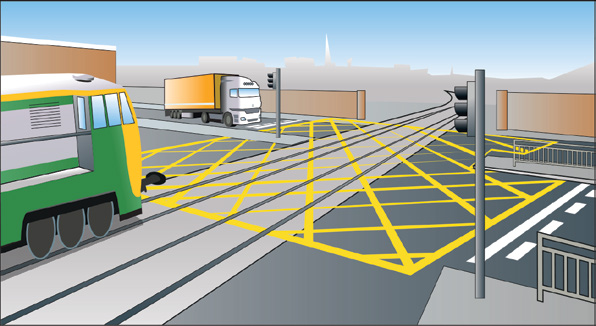
Do not enter a yellow box junction unless you can clear it without stopping.
Where Else You See Them
Yellow box junctions can also appear at railway crossings and tramway crossings. The rule is even more important there.
Why The Rule Exists
Stopping in the box blocks priority traffic and can trap vehicles across a conflict point.
Common Mistakes
- Following the car ahead into the box without checking the far side.
- Treating the box as a waiting area for straight-ahead traffic.
- Entering because the exit looked like it might clear.
Quick Quiz
When may you enter a yellow box junction?
- A. Whenever the light is green
- ✓B. Only when you can clear it without stopping
- C. Whenever the driver ahead entered
- D. Only if you signal first
The key test is whether you can clear the box without stopping.
If traffic is queued beyond a yellow box junction, what must you do before entering?
- A. Enter as long as the traffic light is green
- ✓B. Wait behind the entry line until there is a clear space for your vehicle on the exit side
- C. Honk at the cars ahead to make room
- D. Enter slowly and stop inside the box
You must not enter a yellow box unless your exit path is clear of queued traffic.
The Right-Turn Exception
The exception is real, but narrow.
What Is Allowed
You may enter the yellow box while waiting to turn right if you are waiting for oncoming traffic to clear.
What Is Not Allowed
Do not enter if doing so would block traffic that has the right of way or if the exit is blocked.
Common Mistakes
- Using the right-turn exception while travelling straight ahead.
- Entering even though the road you are turning into is full.
- Blocking cross traffic while waiting.
Quick Quiz
Which case allows entry into a yellow box?
- A. Going straight ahead while traffic may move soon
- ✓B. Waiting to turn right for oncoming traffic to clear
- C. Crossing slowly because the box is large
- D. Any time the junction feels quiet
The recognised exception is for a right turn while waiting for opposing traffic.
Dual Carriageway Lane Use
The left lane is the normal lane.
Default Lane
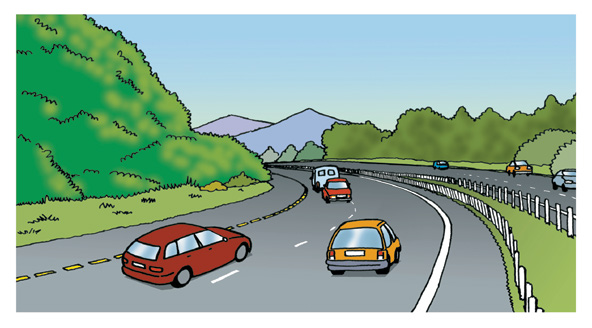
You must normally drive in the left-hand lane of a dual carriageway. The outer lane is mainly for overtaking or preparing for a right turn.
Turning Left Onto One
Turn into the left-hand lane and build speed safely to join the normal flow of traffic.
Turning Right From One
Move into the right-hand lane in good time, use a deceleration lane if there is one, then complete the turn safely into the left lane of the new road.
Common Mistakes
- Entering the outer lane with no reason.
- Braking too late before a right turn.
- Finishing the turn into the wrong lane.
Quick Quiz
Which lane should you normally use on a dual carriageway?
- A. The lane nearest the centre
- ✓B. The left-hand lane
- C. Any lane you prefer
- D. The lane with the least traffic
The left lane is the normal travel lane.
On a dual carriageway, when should you move into the right-hand lane?
- A. To drive continuously at the speed limit
- ✓B. Only to overtake slower traffic or turn right, returning to the left lane when safe
- C. Whenever you prefer the right lane
- D. To allow cars behind to pass on the left
The right lane is strictly for overtaking or turning right. Return to the left lane when clear.
Using the Median Safely
Only use the median if the vehicle fully fits and it is safe.
Check The Space
If the median space is too narrow for your vehicle, wait on the minor road until you can complete the full crossing in one go.
Large Vehicle Warning
For larger vehicles it is generally not safe to treat each side as a separate road. Wait until both carriageways can be crossed safely.
Common Mistakes
- Stopping partly exposed because the median is too short.
- Following another car into a blocked median.
- Assuming a bigger vehicle can use the same gap as a small car.
Quick Quiz
If the median is too narrow for your vehicle, what should you do?
- A. Use it anyway and stop partly in lane
- ✓B. Wait on the minor road until you can clear both sides safely
- C. Signal and expect traffic to slow down
- D. Cross the first side and stop wherever possible
You should not use a median that cannot safely contain your vehicle.
Know the route before test day.
Turn nervous drives into focused practice. Follow independent route patterns with clear, turn-by-turn voice guidance on iPhone and Android.


Built for iPhone & Android
Practise at your own pace