
Roundabouts
Lane choice, signalling, observation and safe decision-making at roundabouts.
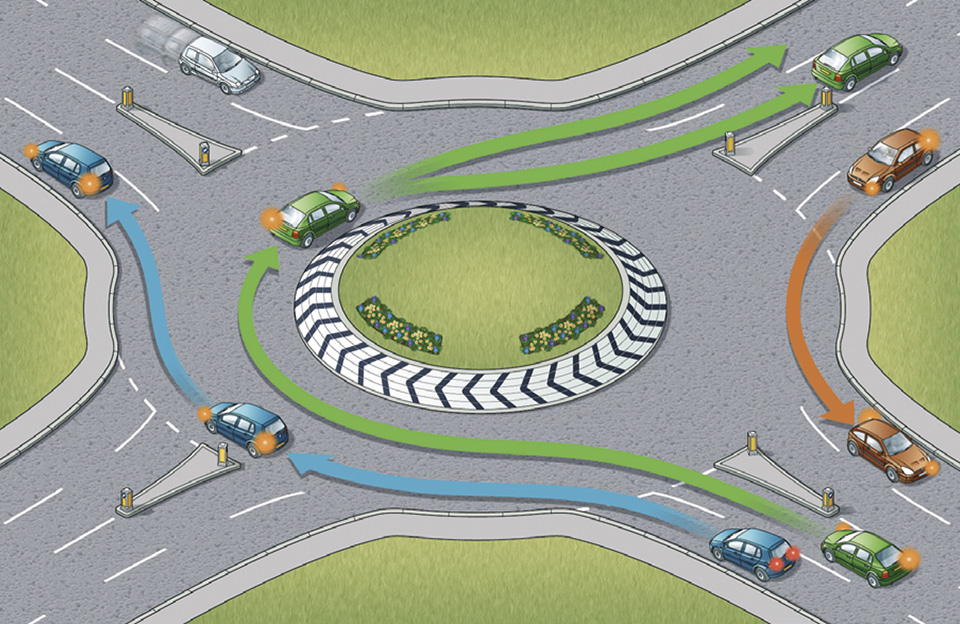
Why This Matters
Roundabouts combine lane discipline, signalling, yielding and hazard awareness, so they expose poor planning quickly during the practical test.
Coach Note
The tester is rarely only judging whether you exited correctly. They are watching your lane setup, traffic reading, mirror use and whether you stay calm under pressure.
Learning Goals
- Use the 12 o'clock rule as a default lane guide.
- Know when lane arrows and road signs override the default rule.
- Signal correctly for left, straight and right exits.
- Yield to traffic from the right or already on the roundabout without freezing unnecessarily.
- Recover safely if you realise you are in the wrong lane.
Sections
The 12 O'Clock Rule
Treat the roundabout like a clock to choose your approach lane.
Core Rule
As a general default, exits from 6 o'clock to 12 o'clock are approached from the left lane. Exits from 12 o'clock to 6 o'clock are generally approached from the right lane.
What Overrides It
If lane arrows, lane markings or road signs tell you to use a different lane, follow them instead of the default clock rule.
Why It Helps
The 12 o'clock rule gives you an early planning shortcut. Good planning prevents late lane changes and rushed steering.
Memory Aids
- •Before the yield line, decide if your exit is before or after 12 o'clock.
- •If painted arrows disagree with your memory, trust the road markings.
Common Mistakes
- Using the right lane for an early left or straight exit without a marking that allows it.
- Treating every second exit as automatic left lane without reading the roundabout shape.
- Changing lane late because the approach was not planned early enough.
Quick Quiz
If your exit is roughly at 10 o'clock on a standard roundabout with no special arrows, which lane should you generally approach in?
- ✓A. Left lane
- B. Right lane
- C. Either lane
- D. Hard shoulder
An exit between 6 and 12 o'clock is generally approached from the left lane.
What should you follow if lane arrows conflict with your default roundabout rule?
- A. Your instructor's habit
- ✓B. The painted arrows and signs
- C. The fastest lane
- D. Whatever the car ahead does
Road signs and markings override the default rule.
If you realize you entered the roundabout in the wrong lane, what is the safest course of action?
- A. Stop immediately and signal
- B. Attempt to cut across lanes quickly
- ✓C. Continue in your lane and take the exit that lane forces, then turn around safely elsewhere
- D. Sound your horn to alert other drivers
Exiting safely in the wrong lane and rerouting is a minor fault, whereas cutting across lanes creates a serious hazard.
Approach and Yield
How to set up early, read traffic and enter safely.
Read the Approach Early
Look for direction signs, lane arrows and road markings before you reach the roundabout. Move into the correct lane in good time.
Treat It Like a Junction
Yield to traffic coming from the right or already on the roundabout, but keep moving if the way is clear.
Choose a Safe Gap, Not a Perfect Gap
A long unnecessary stop can be marked just as poor entry judgement can. If the way is safely clear, commit and go.
Micro Drills
Name the three things you should be reading before the yield line.
- Signs
- Lane arrows or markings
- Traffic already on the roundabout
Common Mistakes
- Stopping automatically even though the roundabout is clear.
- Watching only the lane lines and not the oncoming traffic.
- Trying to decide the exit too late.
Quick Quiz
Which statement is best?
- A. Always stop at roundabouts before entering.
- B. Always keep moving even if traffic is coming from the right.
- ✓C. Treat the roundabout like a junction and yield where necessary.
- D. Wait until the roundabout is completely empty.
You yield where necessary, but you do not stop without reason.
Signals and Exit Patterns
Understand signalling for left, straight and right exits.
Exit Patterns
| Approach Lane | Approach Signal | On Roundabout | Key Note |
|---|---|---|---|
| left | left | continue left | Stay in the left lane and continue to the first exit. |
| usually left unless markings say otherwise | none on approach | signal left after passing the exit before yours | Plan your exit early so the left signal is not rushed. |
| usually right | right | change to left signal before your exit | Do not keep the right signal on while leaving the roundabout. |
Common Mistakes
- Leaving the right signal on through the exit.
- Forgetting to signal left when exiting straight ahead.
- Cutting across a lane on exit because the lane plan was poor.
Quick Quiz
If you are going straight ahead at a standard roundabout, when do you normally signal left?
- A. Before the roundabout
- B. As soon as you stop at the yield line
- ✓C. After passing the exit before yours
- D. Only after leaving the roundabout
For a straight exit, you usually signal left after passing the exit before your own.
Test-Day Roundabout Advice
How to recover from pressure and still look controlled.
Coach Tips
- •If you realise late that you are in the wrong lane, avoid a sudden correction. Continue safely and recover later.
- •A calm, slightly conservative entry is better than rushing into the wrong gap.
- •The tester notices whether you were observing continuously, not just whether you chose the correct exit.
Self-Check
- Did I read the signs before the yield line?
- Did I choose the lane before the pressure point?
- Did I signal correctly before leaving?
- Did I keep scanning traffic, not just the lane lines?
Know the route before test day.
Turn nervous drives into focused practice. Follow independent route patterns with clear, turn-by-turn voice guidance on iPhone and Android.


Built for iPhone & Android
Practise at your own pace