
Mirrors, Lane Changes and Blind Spots
Observation routines that directly affect practical test marks.
Why This Matters
Mirror and blind-spot errors are among the easiest repeated marks to collect in the practical test.
Coach Note
The best way to reduce nerves is to have one observation routine for each manoeuvre, not a different guess every time.
Learning Goals
- Use mirror, signal, mirror, manoeuvre correctly.
- Know when a blind-spot check is necessary.
- Understand that signalling does not create right of way.
- Change lanes early and only for a clear reason.
Sections
Mirror, Signal, Mirror, Manoeuvre
A repeatable lane-change and position-change routine.
Check Early
Use mirrors in plenty of time to understand what is happening behind you before deciding to move.
Signal In Good Time
Signal only when a move is actually possible and you are planning it, not as a placeholder.
Re-Check Before Moving
Traffic conditions change quickly. The second check confirms the move is still safe.
Common Mistakes
- Mirror once and move much later.
- Signal first and decide later.
- Assuming a signal gives you priority.
Quick Quiz
What does signalling never give you?
- A. An intention
- ✓B. Right of way
- C. A warning to others
- D. A chance to be seen
Signalling shows intention; it does not create priority.
When Blind Spots Matter
Mirror checks are not always enough.
Move-Off
Before moving from the kerb or a parked position, check the relevant blind spot just before you move.
Lane Change
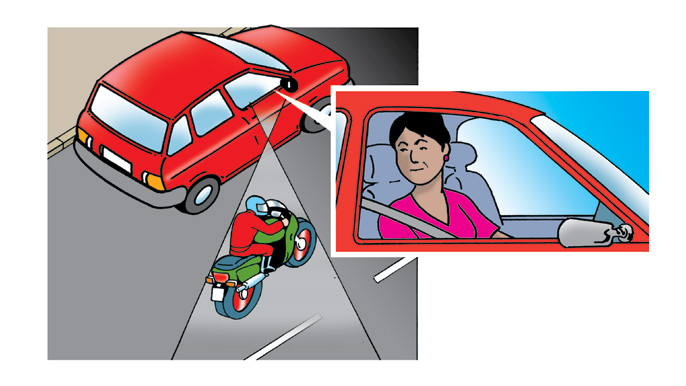
When changing lane at speed, a quick sideways glance confirms that a vehicle has not disappeared from the mirror view.
Cyclists and Motorcycles
Smaller road users are easier to miss in mirrors and can appear in blind zones beside the vehicle.
Micro Drills
Say which blind spot matters before moving off to the right.
- Right-side blind spot
- Final check just before movement
Common Mistakes
- Skipping the blind spot because the mirrors looked clear.
- Looking too long and forgetting forward control.
- Checking the wrong side.
Lane Change Discipline
Do not move lane without a clear reason and a safe gap.
Need A Good Reason
Do not move from one traffic lane to another without good reason.
Who Has Priority
You must give way to traffic already in the lane you want to enter.
Lane Arrows Matter
Near junctions, road signs and lane arrows may require traffic in each lane to take a specific direction.
Common Mistakes
- Late lane changes near junctions.
- Assuming another driver will let you in.
- Ignoring a turn-only lane marking.
Quick Quiz
If another vehicle is already in the lane you want, what must you do?
- A. Signal and move anyway
- ✓B. Give way and wait for a safe gap
- C. Accelerate past it first
- D. Use the horn to claim the lane
You must give way to traffic already in the lane.
Arrange the correct lane changing sequence.
- Check interior and side mirrors
- Signal your intention early
- Perform shoulder blind-spot check
- Smoothly change lane when safe
Mirrors → Signal → Blind-Spot Check → Smooth Lane Change.
Know the route before test day.
Turn nervous drives into focused practice. Follow independent route patterns with clear, turn-by-turn voice guidance on iPhone and Android.


Built for iPhone & Android
Practise at your own pace